
Philadelphia SEPTA Accident Lawyer
Available Now
(215) 636-0160
24/7 for urgent matters
Philadelphia & Media, PA
Direct attorney access
Philadelphia SEPTA Accident Lawyers Who Know the System
Philadelphia depends on SEPTA. Every weekday, the Southeastern Pennsylvania Transportation Authority moves hundreds of thousands of riders across the city and suburbs – on buses, trolleys, the Market-Frankford Line, the Broad Street Line, and Regional Rail. For most of those riders, it’s routine. But when a SEPTA vehicle is involved in a crash, when a platform is left in a dangerous condition, or when an operator makes a deadly mistake, the consequences for ordinary people can be severe and lasting.
At Pagano Law, we represent people injured in SEPTA accidents throughout Philadelphia and the surrounding region. These cases are legally complex – they involve a government agency with its own immunity protections, strict notice deadlines, and damage caps that don’t exist in ordinary personal injury claims. You need an attorney who understands that landscape. We do.
SEPTA is a government agency operating under the protection of the Pennsylvania Sovereign Immunity Act. An experienced Philadelphia SEPTA accident attorney knows how to bring your claim within the right legal framework to maximize recovery.
SEPTA Is a Government Agency – And That Changes Everything
Most personal injury claims follow a familiar path. Someone is negligent, they cause harm, and the injured person pursues compensation through the at-fault party’s insurance. SEPTA accident claims don’t work that way.
SEPTA is a government agency operating under the protection of the Pennsylvania Sovereign Immunity Act. That law shields government entities from most civil liability – but it carves out specific exceptions, including the negligent operation of a motor vehicle and dangerous conditions of real estate. SEPTA buses, trolleys, trains, and station infrastructure often fall squarely within those exceptions. An experienced Philadelphia SEPTA accident attorney knows how to bring your claim within the right legal framework.
The Damage Caps You Need to Know About
Here’s something SEPTA and its claims department won’t volunteer when they’re handling your case: Pennsylvania law limits how much the agency can be required to pay out. Under the Sovereign Immunity Act, SEPTA’s total liability is capped at $1,000,000 per accident, regardless of how many people are hurt or how serious the injuries are. Individual claimants are capped at $250,000 per person.
These limits matter in a few important ways. First, if a serious SEPTA accident injures multiple people, the total pool of available compensation may be depleted quickly – meaning those who file first may recover more than those who wait. Second, because the cap exists, insurance adjusters and SEPTA’s legal team have less incentive to negotiate fairly if they think you don’t fully understand your rights. Working with a SEPTA accident lawyer who knows these caps – and knows how to maximize your recovery within them – is essential.
The Six-Month Notice Deadline: Don’t Miss It
Pennsylvania’s standard personal injury statute of limitations gives you two years to file suit. But SEPTA accident claims carry an additional requirement that trips up many injured victims: you must provide SEPTA with formal written notice of your intent to file a claim within six months of the date of the accident. This notice must include details about the incident, the nature of your injuries, and your medical information.
Miss that six-month window and you may lose your right to any compensation – regardless of how clear SEPTA’s negligence is, and regardless of how serious your injuries are. This deadline is one of the most critical reasons to contact a Philadelphia SEPTA accident attorney as soon as possible after you’re hurt. Don’t wait to see how your injuries develop. Don’t wait to hear back from SEPTA’s claims department. Call first.
Hurt in a SEPTA accident? The six-month notice deadline is real – and it starts the day you’re injured. Contact Pagano Law today for a free consultation before time runs out.
Types of SEPTA Accidents We Handle
SEPTA operates one of the most extensive transit networks in the country, covering buses, trolleys, rapid transit lines, Regional Rail, and paratransit. Accidents happen across every mode of transit, and Pagano Law handles them all.
SEPTA Bus Accidents
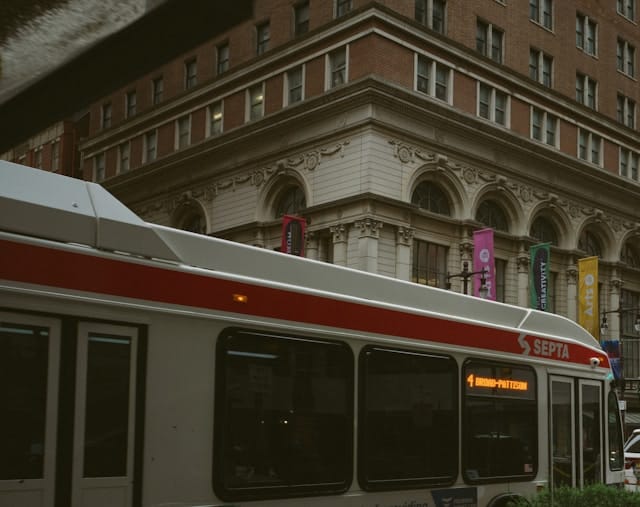
SEPTA buses crisscross Philadelphia on hundreds of routes, carrying passengers through dense city neighborhoods and sharing the road with cyclists, pedestrians, and other vehicles. A fully loaded SEPTA bus can weigh upward of 40,000 pounds. When one of those vehicles collides with a car, strikes a pedestrian at a crosswalk, or makes a sudden stop that throws a standing passenger to the floor, the results can be catastrophic.
Bus accidents are among the most common SEPTA-related claims we handle. They often involve operator error, distracted driving, failure to yield, or buses cutting across bike lanes to reach stops – a growing concern as Philadelphia has expanded its cycling infrastructure. Our team also handles wrongful death claims when a fatal SEPTA bus accident has taken a family member.
For more on how our firm approaches vehicle accident cases involving large, heavy vehicles, see our page on Philadelphia truck accident claims – many of the same principles of size, weight, and negligence apply.
SEPTA Trolley Accidents
Philadelphia’s trolley network – including the famous Route 15 Girard Avenue line and the subway-surface routes (Routes 10, 11, 13, 34, and 36) – runs on tracks embedded in city streets, often through heavily pedestrianized areas. This creates a unique hazard: trolleys share space with people in a way that subway trains and Regional Rail do not. Pedestrian trolley accidents are unfortunately common, and when they happen, the pedestrian almost always comes out worse.
According to data compiled over the past two decades, SEPTA train and trolley accidents have resulted in hundreds of pedestrian injuries and deaths across the system. When you combine the weight of a rail vehicle with the close proximity of pedestrians and cyclists, the potential for serious harm is significant. Our firm investigates these accidents thoroughly – including operator conduct, track conditions, warning signal function, and SEPTA’s maintenance records.
Market-Frankford Line and Broad Street Line Subway Accidents
The Market-Frankford Line (MFL) and Broad Street Line (BSL) are SEPTA’s two rapid transit subway lines. Together, they serve some of the busiest corridors in the city. Accidents on these lines can include slip-and-fall incidents on wet or poorly maintained platforms, injuries from train door malfunctions, falls onto tracks, and collisions.
Platform safety is an ongoing concern across the system. Wet platforms, broken escalators, uneven surfaces, and inadequate lighting all contribute to injuries that SEPTA can be held liable for under the dangerous condition of real estate exception to governmental immunity. If you were hurt at a subway station – not just on a train – you may still have a viable claim against SEPTA.
SEPTA Regional Rail Accidents
SEPTA’s Regional Rail network extends across Philadelphia and into the surrounding counties, operating on lines that include Chestnut Hill East, Chestnut Hill West, Lansdale/Doylestown, Paoli/Thorndale, and others. Regional Rail accidents can involve grade crossing collisions, station platform incidents, and on-board injuries from abrupt stops or derailments.
Grade crossing accidents – where a vehicle or pedestrian is struck by a Regional Rail train at a road crossing – are particularly serious and often involve questions about crossing signal maintenance, operator conduct, and whether SEPTA met its duty of reasonable care. Our firm handles the full spectrum of Regional Rail accident claims.
SEPTA Station Injuries
Not every SEPTA injury happens on a moving vehicle. Stations themselves can be dangerous – particularly older stations that haven’t been adequately maintained. Slip-and-fall injuries on wet platform surfaces, broken escalator accidents, inadequate lighting in stairwells, and assaults that occur due to inadequate security are all situations in which SEPTA may bear legal responsibility.
These claims fall under the premises liability framework as applied to government entities. SEPTA has a duty to keep its stations in reasonably safe condition. When it fails to do so and someone is hurt as a result, that failure can support a personal injury claim. Our firm also handles construction accident claims in and around transit infrastructure – an increasingly relevant area as SEPTA stations undergo ongoing renovation work.
Pedestrian and Trespasser Liability in SEPTA Accidents
One of the more nuanced areas of SEPTA accident law involves pedestrians who are struck on or near SEPTA tracks. Under Pennsylvania law, a person who walks on SEPTA tracks outside of a designated crosswalk or approved crossing zone is technically classified as a trespasser. SEPTA and its insurers sometimes use this classification to argue that the injured pedestrian bears full responsibility for what happened.
That argument doesn’t always hold up. Pennsylvania personal injury law still requires SEPTA and its operators to exercise reasonable care – even toward trespassers – once they become aware of someone in a dangerous position. If an operator spotted a person on or near the tracks and failed to take appropriate action, or if a warning signal malfunctioned, SEPTA may still bear partial or full liability for the resulting injury.
Pennsylvania also follows a modified comparative negligence rule. You can still recover compensation even if you were partially at fault, as long as your share of fault doesn’t exceed 50 percent. Your recovery is reduced by your percentage of fault – so being partially responsible doesn’t necessarily end your claim. An experienced SEPTA attorney can evaluate how fault is likely to be apportioned in your specific case.
What SEPTA Is Required to Do – and What Happens When It Doesn’t
As a common carrier providing transportation to the public, SEPTA is held to a heightened standard of care under Pennsylvania law. That standard applies to every aspect of its operations, from vehicle maintenance to operator training to station upkeep. When SEPTA fails to meet it, the consequences can be life-altering for the people it’s supposed to serve.
SEPTA’s obligations include:
- Maintaining a proper lookout for pedestrians, cyclists, and other vehicles
- Taking reasonable steps to avoid collisions once a hazard is identified
- Keeping safety equipment, warning lights, and crossing signals in working order
- Training and supervising operators to follow established safety protocols
- Enforcing drug and alcohol screening requirements for all operators
- Ensuring vehicles – including brakes, doors, and coupling mechanisms – are properly maintained
- Operating vehicles at safe speeds relative to conditions, curves, and pedestrian traffic
- Maintaining station infrastructure in a reasonably safe condition
When evidence shows that SEPTA fell short of any of these obligations and that failure caused your injury, it forms the foundation of your negligence claim. Building that case requires moving quickly – surveillance footage gets overwritten, maintenance logs get filed away, and witnesses become harder to locate with time.
When SEPTA Vehicles Are Involved in Multi-Vehicle Accidents
Not every SEPTA accident involves only SEPTA. Sometimes a SEPTA bus is part of a chain-reaction collision. Sometimes a SEPTA vehicle strikes a motorcycle or is involved in a crash with a commercial truck. In those cases, liability may be shared among multiple parties – and sorting out who owes what to whom requires careful legal analysis.
Our firm handles the full range of Philadelphia vehicle accident cases, including motorcycle accident claims and truck accident cases, and we’re experienced in cases where SEPTA is one of multiple potentially liable defendants. When a SEPTA vehicle is involved alongside another negligent party, we pursue every available avenue of recovery – not just the path of least resistance.
Philadelphia’s traffic environment makes these multi-party accidents more likely than you might think. As we’ve documented in our coverage of Philadelphia’s Vision Zero shortfalls and what 2025 traffic fatality data means for injury claims, the city continues to struggle with traffic safety on some of its most heavily traveled corridors – the same corridors where SEPTA buses operate daily.
One of the most dangerous of those corridors is Roosevelt Boulevard, where SEPTA bus routes run alongside some of the deadliest traffic conditions in Pennsylvania. Our analysis of Roosevelt Boulevard accidents and your legal rights covers the particular challenges involved in accidents along that stretch – challenges that apply equally to SEPTA-related incidents.
Wrongful Death Claims After a Fatal SEPTA Accident
Not every SEPTA accident ends with an injured survivor. Some end with a death – a pedestrian struck by a trolley, a passenger thrown from a vehicle in a serious collision, a person who falls onto subway tracks. When that happens, the victim’s family may have the right to file a wrongful death claim against SEPTA.
Under Pennsylvania’s Wrongful Death Act, the following people may be entitled to bring a claim:
- The surviving spouse
- Children of the deceased
- Parents of the deceased
- Other family members who were financially dependent on the victim
Recoverable damages in a wrongful death claim can include funeral and burial expenses, lost financial support the deceased would have provided, loss of companionship and consortium, and the pain and suffering the victim experienced prior to death. The same six-month notice requirement applies – and the same damage caps under the Sovereign Immunity Act govern what SEPTA can ultimately be required to pay.
These are among the most serious cases we handle, and we approach them with the care and urgency they require. If you’ve lost a family member in a SEPTA accident, contact Pagano Law to understand your rights and options.
Lost a family member in a SEPTA accident? The legal deadlines apply even in wrongful death cases. Contact Pagano Law for a compassionate, confidential consultation – there’s no fee unless we recover for you.
Evidence That Matters in SEPTA Accident Cases
SEPTA has an internal claims department and legal team that begins working a case from the moment an incident is reported. By the time an injured rider or pedestrian even thinks about contacting an attorney, SEPTA may already be building its defense. That’s why moving quickly – and working with an attorney who knows what evidence to look for – matters so much.
Key evidence in SEPTA accident cases includes:
- Surveillance footage – SEPTA cameras on vehicles and at stations record incidents, but footage may be overwritten quickly if not preserved
- Operator records – including training history, disciplinary records, and any prior incidents
- Vehicle maintenance and inspection logs – showing whether the vehicle had known mechanical issues
- SEPTA’s internal incident and accident reports
- Dispatch and GPS records – tracking vehicle location, speed, and stops
- Witness accounts from other passengers and bystanders
- Medical records documenting the nature and extent of your injuries
- Expert analysis of vehicle data, track conditions, or station infrastructure
At Pagano Law, we move immediately to request and preserve this evidence when we take on a SEPTA case. The longer you wait, the harder some of this becomes to obtain.
What Compensation Can You Recover After a SEPTA Accident?
Subject to the damage caps discussed above, injured victims in SEPTA accident cases may be entitled to recover:
- Medical expenses – emergency care, hospitalization, surgery, physical therapy, and ongoing treatment
- Future medical costs – if your injuries require long-term or permanent care
- Lost wages – income you couldn’t earn during your recovery
- Loss of earning capacity – if your injuries affect your ability to work going forward
- Pain and suffering – physical pain, emotional distress, and reduced quality of life
- Out-of-pocket expenses – transportation to medical appointments, home modifications, and other costs tied to your injury
- Wrongful death damages – for families who have lost a loved one in a fatal SEPTA accident
Understanding exactly what you can recover – and building a complete, documented picture of your damages – is part of what an experienced SEPTA accident lawyer does. We don’t leave money on the table, and we don’t accept lowball offers from SEPTA’s claims department.

How Pagano Law Handles SEPTA Accident Cases
Free Consultation – No Cost, No Obligation
We start with a conversation. Tell us what happened, where, when, and how your life has been affected. There’s no charge and no obligation. If you have a case, we’ll explain clearly how we can help and what the process looks like.
Immediate Filing of Legal Notice
If you retain us, we immediately handle the formal written notice to SEPTA required under Pennsylvania law. This is the most time-sensitive step in the entire process – and it’s our first priority.
Thorough Investigation and Evidence Preservation
We request surveillance footage, maintenance logs, operator records, and any other available evidence before it disappears. We also work with accident reconstruction experts and medical professionals when the case requires it.
Honest Assessment of Your Case
We tell clients the truth about their cases – including the damage caps that apply and what a realistic recovery looks like. You won’t get inflated promises from us, but you will get straight answers.
Negotiation and Litigation
SEPTA and its insurers take cases more seriously when they know the attorney on the other side is willing and prepared to go to trial. We negotiate hard, and we litigate when the offer isn’t fair. Our approach to Philadelphia personal injury cases is the same whether the defendant is a private driver or a government transit authority: we fight for what you’re owed.
What to Do After a SEPTA Accident
- Seek medical attention immediately – even if your injuries seem minor. Some injuries, including traumatic brain injuries and internal damage, don’t present fully until hours or days after the incident.
- Report the incident to SEPTA on the scene – ask that a formal incident report be completed, and note the vehicle or route number, operator name, and badge number if available.
- Document everything – photograph the scene, your injuries, and any visible hazards before they’re cleaned up or repaired.
- Get witness information – names and contact details for anyone who saw what happened.
- Don’t give a recorded statement to SEPTA’s claims department or its insurance representatives without speaking to an attorney first.
- Contact Pagano Law as soon as possible – the six-month notice clock is already running.
The Federal Transit Administration sets safety standards for public transit systems nationally, and the National Transportation Safety Board investigates major transit accidents. When SEPTA fails to meet those standards, riders and the public pay the price. You have the right to hold the agency accountable.
Why Choose Pagano Law for Your SEPTA Accident Case
Philadelphia has a lot of personal injury firms. What makes Pagano Law the right choice for a SEPTA accident case specifically?
- We know the Pennsylvania Tort Claims Act and the Sovereign Immunity Act – and exactly how they apply to SEPTA claims
- We understand SEPTA’s internal procedures and how to navigate them to get the evidence we need fast
- We’re Philadelphia-based – we know these neighborhoods, these transit corridors, and these courts
- We handle cases on contingency – no recovery, no fee
- We communicate honestly – you’ll know the realistic value of your case and what to expect at every stage
- We’re prepared to litigate – SEPTA’s legal team knows which lawyers will actually take cases to trial, and that matters in negotiations
Our clients aren’t case files. Whether you were hurt on the Market-Frankford Line, struck by a SEPTA bus on your way to work, or suffered a platform injury at a Regional Rail station, you deserve an attorney who takes your situation seriously and fights for a real outcome.
Contact a Philadelphia SEPTA Accident Lawyer Today
SEPTA has the resources of a government agency behind it from the moment an accident is reported. You shouldn’t face that alone. At Pagano Law, we level the playing field – handling the legal complexity, the evidence gathering, the notice requirements, and the negotiation so you can focus on recovering.
If you or a family member was injured in a SEPTA bus accident, trolley crash, subway incident, Regional Rail accident, or station injury anywhere in the Philadelphia area, contact us today for a free consultation. We serve clients throughout Philadelphia, Delaware County, Montgomery County, and Bucks County, and we’re available to discuss your case at no cost and no obligation.
The clock is running. Reach out to Pagano Law now.
What We Handle
Key areas we fight for you
Track Record
Legal Case Results
Client Stories
What clients say about us
Questions about Philadelphia SEPTA Accident Lawyer
Our attorneys field these questions daily. Here are the most common ones — but every situation is unique. Call us for a direct answer about your case.
Speak with an AttorneyHow much can I sue SEPTA for?
Under the Pennsylvania Sovereign Immunity Act, SEPTA’s liability is capped at $1,000,000 per accident and $250,000 per individual claimant. This is lower than what you could potentially recover in a claim against a private party. Understanding these caps – and how to maximize your recovery within them – is a key part of our strategy in every SEPTA case.
How much can I sue SEPTA for?
Under the Pennsylvania Sovereign Immunity Act, SEPTA’s liability is strictly capped at $1,000,000 per overall accident pool and $250,000 per individual claimant. This differs heavily from private lawsuits, making it absolutely essential to hire a lawyer who knows how to urgently maximize your recovery within these strict government caps.
What is the deadline to file a SEPTA accident claim?
You must provide written notice to SEPTA within six months of the accident. Pennsylvania’s general personal injury statute of limitations is two years, but missing the six-month SEPTA notice requirement will bar your claim entirely, regardless of how strong your case is.
Can I file a claim if I was partially at fault?
Yes. Pennsylvania uses a modified comparative negligence rule. You can recover compensation as long as you were less than 51 percent at fault for the accident. Your recovery will be reduced proportionally by your percentage of fault. A SEPTA attorney can evaluate how fault is likely to be assigned in your specific situation.
What if I was injured as a pedestrian struck by a SEPTA vehicle?
Pedestrians struck by SEPTA buses, trolleys, or trains may have a viable claim against SEPTA – even if they were crossing outside a crosswalk. SEPTA and its operators owe a duty of reasonable care to the public, and that duty doesn’t disappear simply because a pedestrian was in an unexpected location. Each case turns on its specific facts; contact us to discuss yours.
What if I was hurt at a SEPTA station rather than on a vehicle?
Station injuries – including slip-and-falls on wet platforms, escalator accidents, and assaults resulting from inadequate security – can support a claim against SEPTA under the dangerous condition of real estate exception to sovereign immunity. If SEPTA knew or should have known about a hazardous condition and failed to address it, the authority may be liable for injuries that result.
Does Pagano Law handle SEPTA cases on contingency?
Yes. We handle SEPTA accident cases on a contingency fee basis, which means you pay nothing unless we recover compensation for you. There’s no upfront cost to hire us and no hourly fees.